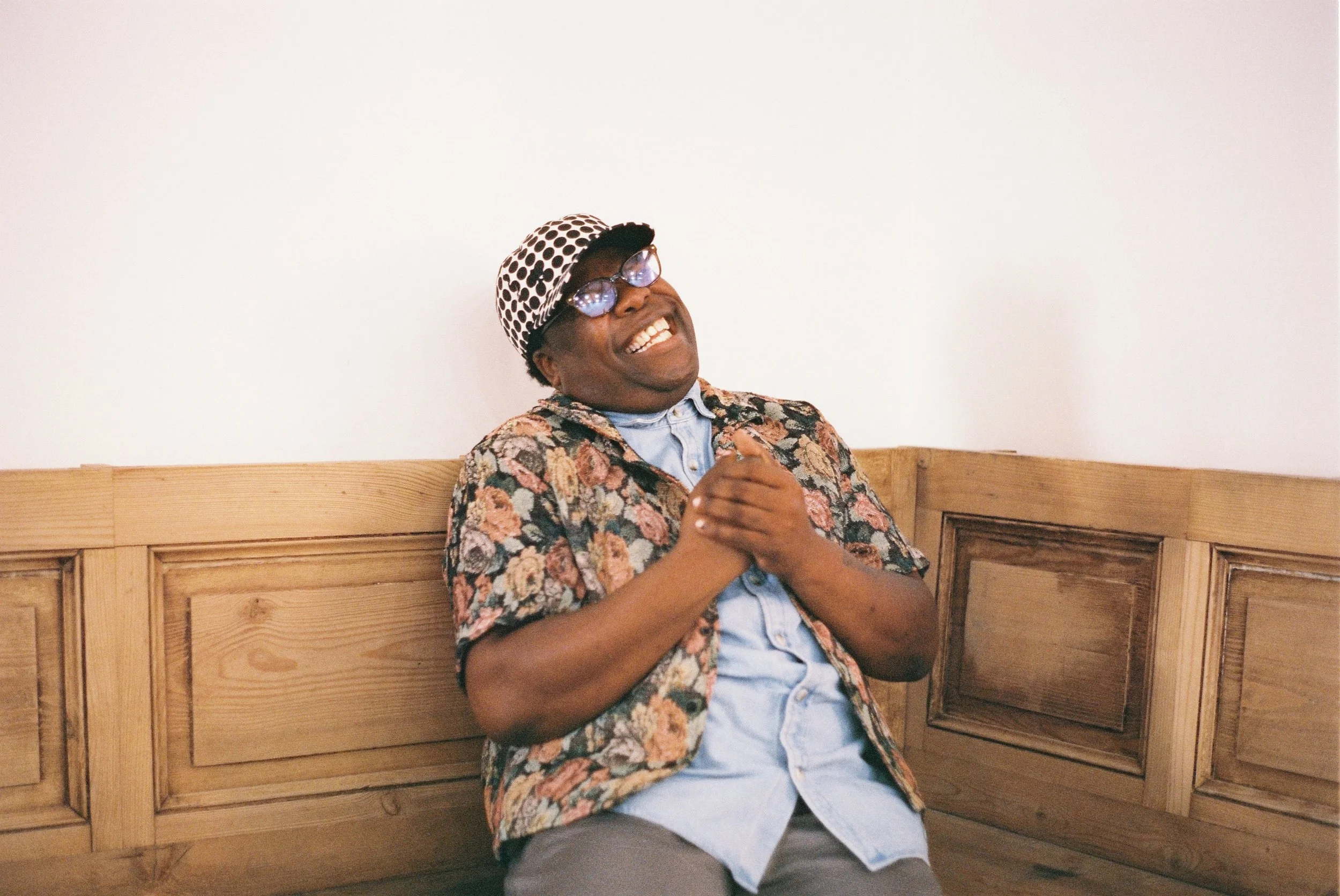
avery r. young is a Black church if i ever saw one
introduction
In June 2025 I attended Cave Canem’s annual retreat in Greensborough, Pennsylvania for the first time. avery r. young surprised the fellows at an evening reading and was invited to share.
avery is all my theory about art and spirituality made flesh so he did what he does—surging into song with no disclaimer. His body—an instrument moving through the room, shifting the air’s weight; it’s very texture into breathable oil. avery blended gospel and blues—turning this otherwise secular space into a sacred Sunday morning. He sung,
Rabbi, had you been here, Trayvon would still be around
Jesús, where you been…inside this land called now?
Jesús where you been, inside inside this land called right now?
Churchy as I am, I fell into his rhythm without hesitation. I shifted my knees to the floor—surrendering to what this moment had become. In our interview, Avery says, “Anybody that's seen me do a work—if they ever been to a church, or a Black church specifically knows, oh, that's what he's doing. He's doing Black church. He's having Black church.”
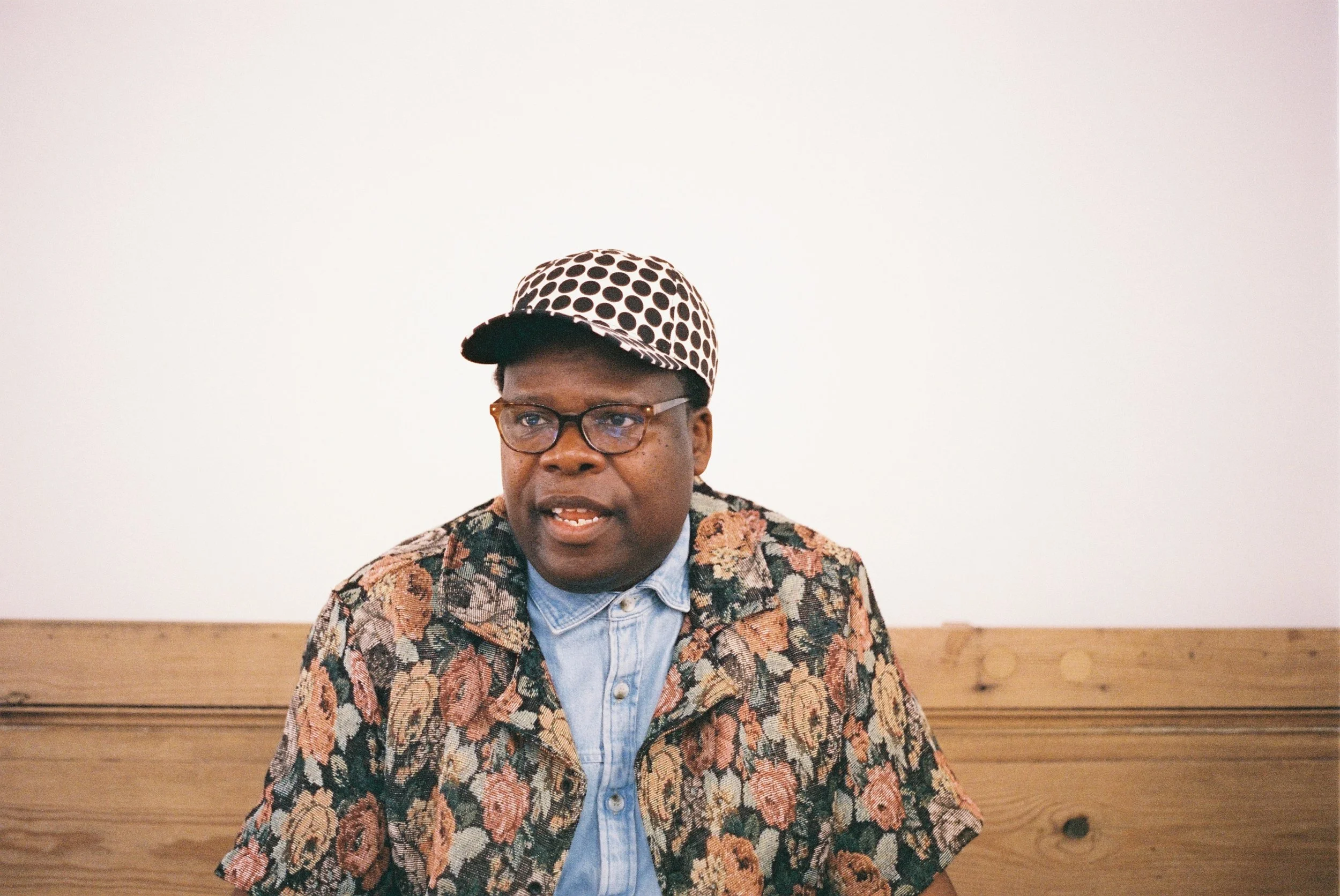
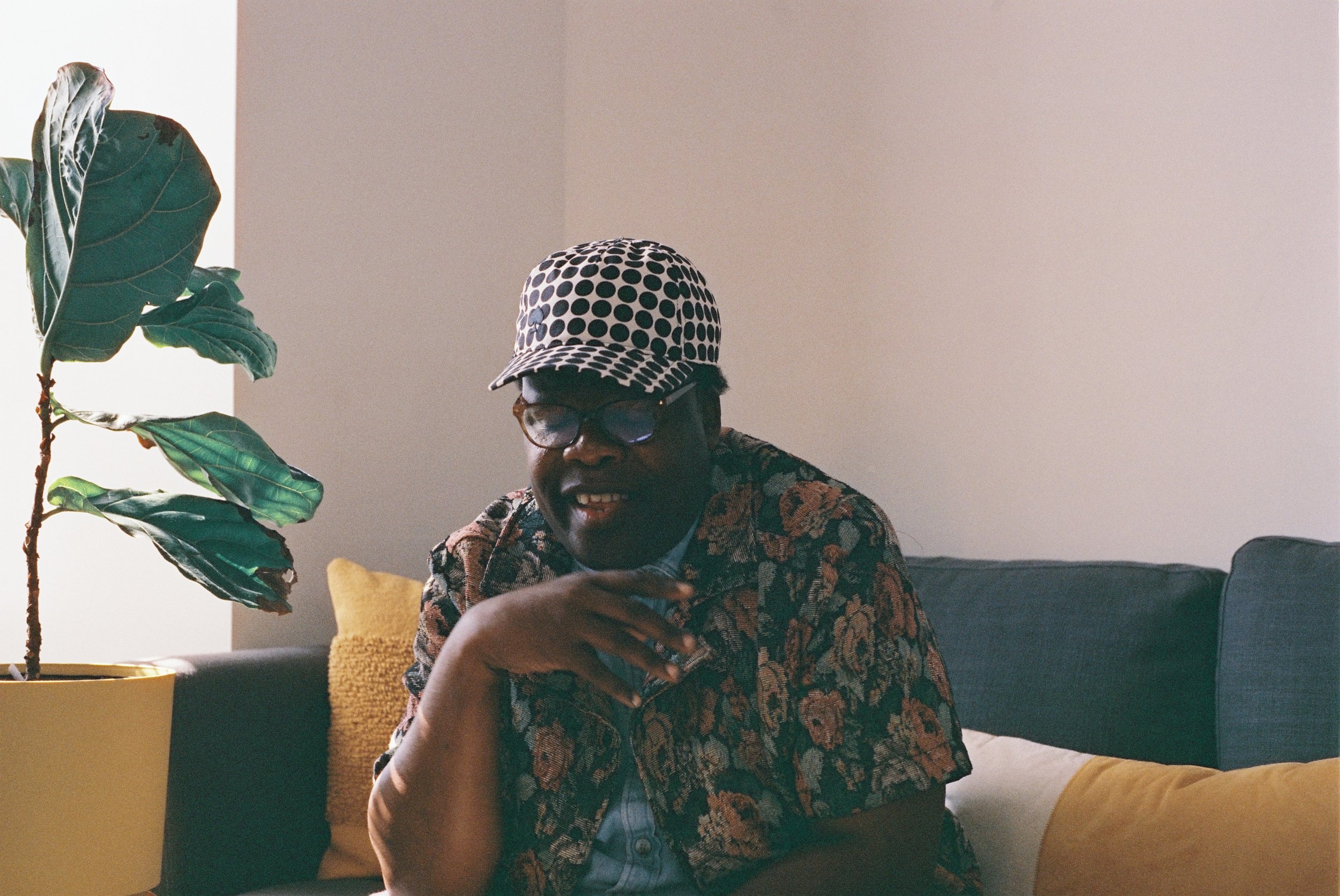
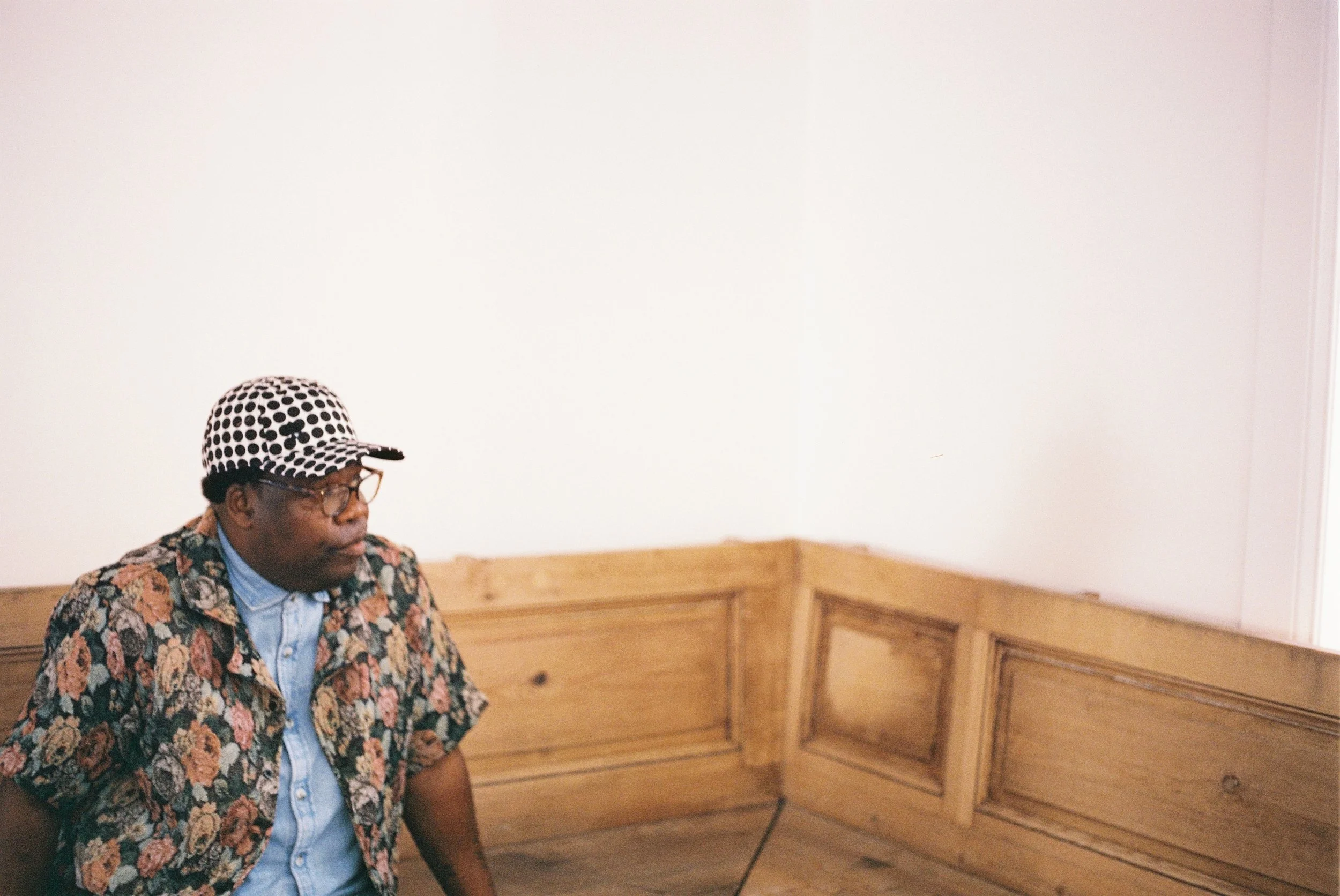
I interviewed avery in Chicago a month later at The Burroughs House on The Historic Property of Dr. Margaret Burroughs. avery permitted me my amateur archival practices without critique. Me—fumbling with my 35 millimeter film camera, trying to capture him. Me—forgetting extra batteries for my audio recorder and having to transition to the voice memo app on my phone.
It didn’t matter. From the moment I pressed record, what avery offered me was akin to sermon more than interview. I sat on the floor watching him, mostly from my view finder, adjusting the light’s entrance—feeling the Spirit move as we spoke.
Our conversation has been edited for length and clarity.
interview
When avery and I first sat down at The Burroughs house, I shared that I was having spiritual encounters in secular places with Black art. I shared that the work of Black artists saved my faith. I shared that Black art had became my church and scripture. avery understood immediately.
avery: A lot people are disconnected from congregant fellowship. They're not going to church for whatever reason. They don't necessarily think church is a space they can go back to. I don't necessarily believe in the concept of going to church. I come with church.
Church is fellowship. And it's not exclusive to a church house. So that is what's happening in poetry. A lot of folks think it's intellectual, but it's definitely, to me, housed in the body. I don't think a poet should ask the Wizard of Oz for a brain. The poet has to ask for home. The poet is Dorothy.
Maybe because poetry as an art, or as an industry, is so tied to academia, we think it more so intellectual. But language through the body—presents some level of energy that brings forth Pentecost. In that sense, some spiritual transformation happens. In most cases at a poetry slam or poetry event, people are there to touch and agree. And that's what's happening when you go to church on Sunday morning. Or Bible study. Or a tent revival.
I have a project on pause, but the title of it is Where They Come to Worship. It is about poetry gatherings and the ways poetry feeds people. I came up in the church so I see it. Church is not a source of trauma for me. Black people in worship are magical beings. To me, Black people in worship are the most powerful. We get to talk about healing and the wind there—the Holy Ghost.
I think it's important to understand that in the Book, when Jesus says to Peter, go walk on the water, the whole point is, Jesus is saying whatever it is y'all think makes me the Messiah is in you too. He’s a rabbi, but the power in revolutionizing people makes Jesus dangerous enough to kill. Jesus is saying, this is not just me. If you know about you what I know about me, you would do this too. If you had the knowledge of yourself the way I know what I'm here to do—you could walk on water too. Jesus says, Look, Peter, you're walking on water! And Peter only falls in the water when he realizes, oh shit, I'm not supposed to be on water. But if I know I can be on water, there's nothing to be submerged in. I can sit, I can stand on water, just like Jesus. And that's what made him dangerous. Because he was like, this ain't just in me. This is in you. So why would you pay any penance to Caesar?
ajanaé: Yes! I love that reading. And it’s the touch and agreeing that makes that ecstatic experience possible to me in the art world. It’s the way we all agree to surrender at the same time.
avery: The fortification of Pentecost only happens if we touch and agree. We all gotta bring something to the table. And that's what's happening in poetry. Everybody's bringing something.
Now what they're bringing could be a number of things. Somebody could be bringing a ruckus. Somebody could be bringing drama. Somebody could be bringing comedy. Somebody could be bringing the pure beauty—the beauty of sonics and rhythm when they speak. Everybody is bringing a story or a testimony. That's why it's like testimony service. Testimony service is not so I can just hear. Testimony service is a people in witness of a person's narrative. Which is a slam. People agreeing to be a witness of a person's narrative. And then the freedom to then share that narrative. That's a slam, outside of the scores.
ajanaé: Yes! I feel like testimony service is the most democratic part of any church service. You don’t have to have any vested authority, any credentials…you don’t even have to be a Christian. For that moment, you are an authority on your encounter with God. And you are affirmed by an audience of people who believe in this moment with you. You are affirmed by people who are happy you survived. I based this project, in part, off the testimony service and definitely what I’ve felt in poetry slams.
avery:
Poetry slams, poetry readings are Sunday service. They are tent revival. The same thing is happening. The body is telling a story. The body is in testimony. The body is a witness of a thing that I got through or a thing that's made it really hard to walk.
Thomas Dorsey loses a whole wife and child in the act of this woman giving birth. And after that, he writes,
"Precious Lord, take my hand.
Lead me on, let me stand.
I am tired, I am weak, I am worn.
Through the storm, through the night.
Lead me on to the light. Take my hand,
Precious Lord, lead me on."
That's a poem all day. That's also the blues. That is faith work all day. That's a conjuring all day, every day.
He is saying—dude, I ain't going nowhere. I ain't doing nothing if you don't come get me. I'm distraught. I'm so emotionally aware that I can't think my way out this. My tentacles are so exposed right now. All I can do is stand here and wait on you to take my hand and move me forward. And he figured out how to make that rhyme—how to turn that level of emotional awareness into poetry and song—that's Black shit all day long. And when Mahalia sings Precious Lord, it’s not the Precious Lord that Thomas Dorsey wrote. Precious Lord out of Mahalia's body is based in her experience.
ajanaé: I had no clue that is what inspired that song. When you perform, whether song or poetry, that’s how your work feels for me.
avery: Anybody that's seen me do a work—if they ever been to a church, or a Black church specifically—knows, oh, that's what he's doing. He's doing Black church. He's having Black church. And I do it intentionally because I understand Black church is a space where Black folks were able to pray. It was the space where Black folks gathered, galvanized, and liberated themselves.
This is my practice because as a little kid, I was fascinated by what I saw the preacher do. I was fascinated by this person that could stand up in the pulpit and cause these people—or at the time I thought he was causing people—to cry and rock and jump up and dance, clap hands, play a tambourine or something. I thought that dude in that pulpit was fly. He starts talking and people sit down and pay attention. They are at a point of ecstasy. They really have no control of how it shows up out of the body.
You can twerk, cut a G, or praise dance. It takes the body to do either. And they are both communicating something. I don't necessarily think that either is good or bad, evil or righteous. But I do believe that they are both documentation that I got arms, or hands to clap with. I got feet to stomp with. I got a voice. I have a body that at this point ain't shaped to be still. You see what I'm saying?
As a little kid, I thought that what the preacher making out of his body was somehow controlling my big mama's body. But what I know now, especially when I do it—it's not something that I make people do. It's something that I call out of people.
Most poets don't “dress” the stage. Because that's not the requirement to read or recite poetry. You're moving into theater when you are talking about blocking or dressing the stage. But I am completely of the understanding that Black people listen and talk a whole different kind of way that requires movement when it's from liberation. I don't think you can keep still if somebody says like fire shut up in my bones. And if fire is in your bones, you move.
My first experience of how you bear witness to things that happen to your life or things that you read in a book is a physical memory. Not just physical from the preacher or the singer or the choir, but physical from people who are responding. I don't know you heard me based on what you said. I don't know you heard me just because you're quiet. That's not Black listening. That's not Black communication. Black communication is when your big mama said, if you can holler, you can hear.
Now whether or not you're feeling what you just heard is a whole other situation. Whether or not you're understanding what you just heard is a whole other thing. But the expectation is that we don't listen or talk in a still manner. We do it through the body. If I couldn't clap my hands, I would stomp my feet. If I couldn't run, I would walk. If I couldn't say a word, I would wave my hand. There is the body to communicate something and that's its purpose. Its purpose is not to constrict itself.
ajanaé: I love how deeply you lean into the importance of the flesh in our art and spiritual practice.
avery: How else are we going to be righteous if not through the body? What are you going to do that's going to be righteous that won't require your limbs, your mouth, your understanding? It all comes from you. I’d be a fool to believe that something outside of my body happened to make what I do with my body righteous. Righteousness is in my intent, which again, is internal.
Now, it gets convoluted in religious practice. We've been tricked, especially Black people. We've been tricked to believe that the body is nasty. That the body is not pure. That the body somehow isn't righteous. But how else are we going to be righteous if not through the body?
The body is a powerful entity. The body is not incorrect. You know what I'm saying? Because the body is so attached to our spirit and our mind—it's very precise. The Holy Ghost hits because everything aligned where it's supposed to be aligned.
I'm not doing church. I am opening up my body, which happens in church. It's not exclusive to church. You can open up your body when you fucking. You're supposed to be opening up your body when you're on the dance floor. You're supposed to be opening up your body when you're cooking. Your body is supposed to be open. It ain't cool to live a life with that motherfucker closed. You know what I'm saying?
I think about Harriet Tubman. She couldn’t run if her body wasn't open. She don't need a fucking map. Because what sense does that make? If you give me a map, then that means you know where the fuck I'm at. And this is not successful if you know where I'm at. Because what I'm following is bigger than me and you. I'm following the sky. I'm following my spirit. The Lord is going to let me lay down for a couple of minutes. And the Lord is going to tell me where to go. And I'm going to wake up and I'm going to go follow what I got in my dream. But I got to be in tune. My body got to be open. And when you open your body, a lot of the noise go mute.
ajanaé: I love talking about spiritual-embodied experience as a kind of precision. I feel like it’s often thought about as chaos or an imprecise branch of folk magic. Your example of Harriet Tubman makes me realize it’s imprecise to those who don’t have the tools…who don’t know what it is to be in their body.
avery: Harriet Tubman is an Afrofuturist. She has to see herself in a state that's not her present in order to make it to whatever land her feet can stand on and say, I'm a free citizen. She was in a land where it was law that somebody can take her and bring her back to where she ran from. So not only does she got to get to this place, she got to stay in this place. But Harriet said, uh-uh, I'm going to go get some more folks. Because guess what? Slavery ain't no thing over here in my brain. Slavery ain't no thing over here in my heart. Thank you Jesus, it ain't a thing in my body. So I can move all around this mug because ain't no shackle greater than my self-realization. Ain't a shackle made stronger than what I realize for myself. And that's power. And that's what makes spiritual practice necessary. Like if you don't have it, figure it out. Because it's necessary. Because it helps you move against, against, against.
Resistance is an act of faith. It takes prophetic vision. I say Harriet Tubman's an Afrofuturist because she has to see herself in a state that's not her present. It wasn't rationale that said let me go run. It's all imagination.
The best thing to me about church in these times that we are living in now, is that I grew up around Black people. Yeah, my mama would whip my ass and really fucked up shit happened. But Black people would look each other in the face and say Pharaoh's army drowned in the Red Sea. They looked at each other and believed. Mary don't weep. Tell Martha not to mourn. What they're basically saying to each other is that executive power is not absolute power. Fuck Caesar. He can't do what my God can do on no day. And greater is He that is in me than He who is in the world. You know what I'm saying? Greater is He who is in me than anything that the world could devise. That's why praise is necessary.
We live in a world where really fucked up shit happens to us all the time. That's why I'm saying spirituality is necessary. Because we learn we are bigger than the transgressions. It's necessary to understand that. Art allows us to call transgressions, transgressions. Art allows us not to figure that we are rewarded because we are long-suffering. Art says, fuck suffering. Fuck suffering and smiling. That's what Fela Kuti is saying—suffering and smiling. We ain't gotta do that.
I was just telling somebody, when you want a strawberry, do not settle for a watermelon. And many people do that. They want a strawberry. They say, Lord, give me a strawberry. And the Lord throw a watermelon in their face. They go, thank you, Jesus. I'm going to eat this watermelon. Well, what you just told the Lord is you don't really want a strawberry. You’ll accept a watermelon.
God, to me, is when what you say matches what you do. When what you attain is what you desire. If you are looking for the truth, well, then an explanation cannot suffice. The truth will only suffice. I promise you.
ajanaé: Harriet Tubman was absolutely an Afrofuturist. I believe imagination is a spirit—That it’s morally neutral. I mean you can call on good or bad spirits to imagine. People imagine new ways to commit evil and violence. And so to counter that…how are we imagining? People have dedicated their imaginations to building hell on earth so we must commit our imaginations to building heaven on earth.
avery: Heaven can't be no shit I find out about when I die. Because if I believe that whole process of heaven means I'm going to be a new creature, that means my flesh is never going to experience heaven? Hallelujah, I'll die or I'll fly away. For some people, divorcing a motherfucker is heaven. I am emancipating myself from the hell that this motherfucker has put me through. And once they can let go of being angry at a motherfucker so long—they can understand the bliss that they give to themselves.
I have to make a conscious decision to place heaven on earth. And understand that it's not necessarily exclusive to whether or not I have a Bible in my hand.
What does that say to your point about igniting an imagination that places heaven here, and not just when I die? Poets gonna write about what they know, what they research, what they witness. Lord have mercy. Why we don't think we can write about some shit that popped off in our imagination—I do not know. Because basically, imagination is saying, I'm about to make this so. It ain't here, but I'm about to make it happen by saying it. That's God. Because it says in the Book, let there be light. And there was. Poems got to be close to God because it’s the word. It really is.
ajanaé: My favorite poets work with prophetic imagination by helping us imagine alternate worlds, heavens, desires, etc. I am always surprised by how many of those writers have origins in the Black church. It’s like finding out all the old blues and soul singers sing like that because they were trained in gospel choirs.
avery: The thing about the minister and the musicians—they're charismatic. If you boring, ain't nobody listening to you. They won’t even understand what you mean. If you are boring, won't nobody engage you. Because again, what you have to ignite from a person is inner. So you have to be charismatic.
Jericho Brown does what comes out the body of Jericho. I feel prayer on Jericho. Even when Jericho's laughing. Jericho—that's my home. That's a brother right there. We lollygag but I feel like if I'm the preacher, he's the deacon. He's the one praying. I'm the one preaching. And there is a power in prayer. Because folks are always standing in the need of it. Prayer changes things.
I think preaching addresses situations, but prayer changes things. When you want to change, you pray. When you want to be informed of something, you preach. When you have to inform somebody, when you have to announce something to somebody, you preach. That's a sermon. A prayer is when you decide that there needs to be a change.
I believe when I perform, I want to transform the room. That's not necessarily changing the space. This library that I'm in, or this concert hall I'm in, this vacant room that I'm in right now on this stage or whatever—I want to transform to the storefront church where I learned this work first. Where I saw this first. This is where I want to make this space right now. And so I'm paying attention to.
I'm paying attention to the dude who had his eyes closed. I'm paying attention that the dude was repeating something over and over again. I'm paying attention that this dude's feet was in the ground and body was rocking and that there seems to be some means in which this dude is traveling and not necessarily here all the way. That this dude is open so much that he's carried to another space. I see the things that's in my head. And depending on how deep I am in that joint, I ain't going to sleep later. Because I done called it. I done called it into the space. I done called it into my bones.
ajanaé: Can you talk about where you’ve encountered God recently?
avery: It's not a hard answer. It's just so much of an answer. You got to understand God ain't in just good things.
1. God—somebody recently physically attacked me. And I knew God was evident. Not in their aggression towards me. But in the message of—this person doesn't deserve this level of access to me. Because there's nothing in me that's going to hit the person back, which is real wild style because I ain't a motherfucker that ain't never going to hit nobody back. But the thing that hit my head was, okay, you got some real important shit to do in two days. And if you decide to right now respond or react in a way different than I did—one of y'all might not make it. And so the evidence of God is 1. I am alive from that situation. 2. I am removed from that situation. 3. There is nothing in my body that is holding that situation. Because God showed up.
2. In London, I went to see a Frida Kahlo exhibition with Krista Franklin. And the curator decided to mount a lot of those photographs at the eye level of Frida Kahlo. They were mounted low. Not like a standard exhibition.
When you walked and saw Frida Kahlo’s life—and you saw what she painted through—that level of physical pain. She was never not in a space where she did not feel some level of physical discomfort. But she managed to fuck, paint, live. She managed to do all that with this body that was broken for years.
And when you walk through that exhibit, that testimony smack you all in your face. There was people from all over the world there. It was a spiritual experience. We all cried. Which to me means that was Pentecost. We all had touched and agreed. We all were like this moment is phenomenal. Thank God she lived. Thank God she woke up and said, fuck this pain, I'm gonna paint. And like, if life ain't about telling people what the fuck I'm living for, then what is?
And again, that to me brought me back to Baptist church and testimony service. The lady that was standing next to me, her face was red as my eyes. I'm crying, she's crying. And she don't even speak English—she and whoever she was with. And all you're hearing in this gallery is sniffing. That's all you're hearing. It's like, it's the score. It's the score of this gallery—of this experience.